Opposite to the traditional German folk song “Die Gedanken sind frei” (All thoughts are free) I claim otherwise. I will explain this in strictly logical terms, giving examples and scientific evidence, while the insight itself only came after long meditation.
Repetition of thoughts
Let me start out with the fact that first of all, thoughts are not really new. Well, statistically atleast.
A scientific study has shown that the average person thinks 60.000 thoughts per day. 80% of those are negative and 95% of those thoughts are the same we thought yesterday. source
Among cognitive scientists it is furthermore recognized that per rule of thumb 95% of all thoughts are unconscious. source

So the thoughts that are not new could be compared to a cassette tape, which is being played over and over again. Sometimes parts are overwritten with new bits, but mostly it stays the same. Meanwhile you're sitting next there, jamming along to the lovely tune you have build, thinking you're smart. That's most likely also one bit on that cassette tape by the way. “I'm smart” - how many times have you played this thought up until now? 100.000 times?
Of course statistically speaking the thought is much more likely to be negative. But the point being that the actual window for new information and change is diminishingly small.
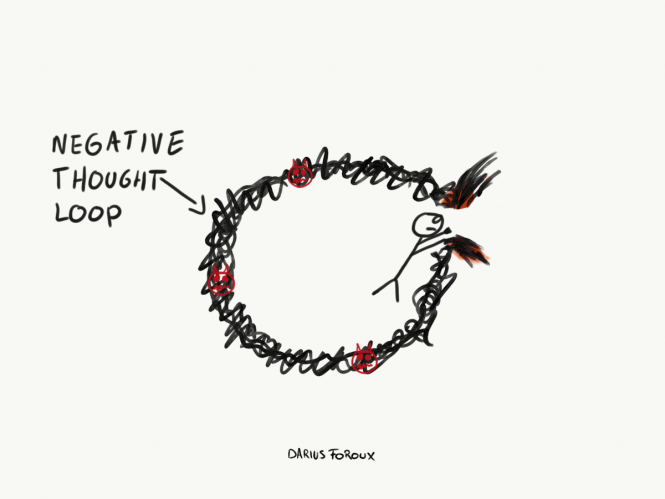
It is under these terms that I mean our thoughts are not free. Yes, thinking is a process which involves activity, and consciousness at a certain level, but if thoughts literally repeat themselves day by day, you could hardly call them free.
If we can accept this, then we might ask what to do about it? What is the nature of this unconscious pattern?
Useful repeating thoughts
Before we throw the baby out with the bathwater, let's start looking at the positives. One way we actually like cyclic thought is with discipline. With discipline you have a core commitment. Then all your actions and thoughts align around this principle.
If you can recall anything which you do throughout your day which you don't really like doing, which doesn't make you joyful, this involves discipline. Otherwise you wouldn't do it. At the core of this discipline and the thoughts, routines and emotions surrounding it lies a core belief, plus an emotion. That's why you could only break out of a discipline or cyclic pattern by doing something absolutely crazy, something that you don't believe in. Unconscious motion is powered by a belief.
With discipline especially we see the purpose of this technique of thought-repetition. Having your thoughts move in circles, painfully repeating themselves everyday, having everything align to a core belief or mission, it is tiring, boring and taxing, but is also useful.
This is maybe were my critique of unfree thought ends. It is not useless. In fact, it is incredibly useful, that's why were doing it. But if all our purpose on this earth is to do useful things and mark off a checklist, we're wasting the other 95%.
One more big example of this is identity. You have an identity, which is not only thoughts, but also a feeling. A feeling of comfort, of knowing who you are and how “the world works”. The ego, like all cyclic thought, allows you to relax and align yourself, but it also makes you walk in circles.

An example how the ego is such a mass of energy, or a core around which everything moves can be found in conversations. Everything in a conversation with somebody will be related by you to yourself, and put in order, to “fit”. Everything gets aligned according to your viewpoint. If you find conversations where this doesn't happen, this indicates that true progress is made and new thoughts are happening. Otherwise history is just repeating itself, getting recycled and applied to a new situation. You're moving within the 95%.
Walking in circles means there is no progress. In the big picture throughout your life you just stay at exactly one place, until your life energy eventually runs out.
On the surface you might have done many feats, but on a deeper layer you probably stayed exactly where you were.
It is this insight and this desperation from beginning to observe ones own cyclical movement, and from realizing time is limited that the motivation for self-realization arises. Who am i? What do I know about who I want to be?
Breaking thought patterns in meditation
One thing is clear, once the cyclical movement is dropped, you drop a burden. In meditation I experienced this as a cluttered ball which moved away from me, with my body immediately sighing. Keeping up a cyclical movement and staying unfree is a burden to the system. It drags you down, but also grounds you in a way. How heavy this burden is and how unfree your thoughts really are can only be understood, once you feel them dropping away during meditation. Suddenly you feel a burst of creativity, and you realize you're free to think whatever you want.
This is an incredible experience.
Once these thoughts are dropped, you still need direction though. You need a solid foundation, and a strong intent. You just kicked off the training wheels. Now you have to drive on your own. You can drive much faster, freely and unrestricted. However you have to keep your balance, and you now run the risk of crashing down, which was not possible before.
It is at this moment that the thoughts are actually free. This is why the title goes “Our thoughts are not free”. Thoughts have the potential to be free, but this is hard and we're generally not making use of it.
Closing thoughts
I hope this could inspire something new in you, I hope this article made it into that window of 5% new thought, and I wish you the best of luck and want to encourage you going on this journey.
Update : Roughly 8 months after writing this I discovered a video from Jiddu Krishnamurti in which he touches on the same topic. He even makes the same point I'm making here, using even the same argument: thoughts cannot be free if they go in cycles. I'm immensely happy to have reached the same conclusion as such a great and influentual spiritual leader.
The exact argument starts at 57:43, while he reaches his conclusion at 1:01:11 when he says: Thought is never free. How can it be? It can imagine what is freedom. It can idealize what freedom should be. It can create an utopia of freedom. But thought in of itself is of the past, and therefor is not free, and it is always old! Right? Please, it is not a question if you are agreeing with the speaker, that's a fact.
In the end it is not important though what I say or what anybody says, but it is important to find out for yourself.